

Welcome!
Protecting and Strengthening Home and Community-Based Services (HCBS) Toolkit
Don’t worry if this seems complicated.
You don’t have to become a policy expert to make a difference. This toolkit explains HCBS in plain language, breaks complex topics into manageable pieces, and gives you practical tools to help you understand the topic and speak up with confidence.
Helping protect and strengthen the services that enable people with disabilities to live, work, and thrive in their communities.
Whether you spend five minutes or an hour, you’ll leave knowing more than when you started.
Everything you need to understand Home & Community-Based Services (HCBS), why they matter, the challenges they face, and how you can help protect and strengthen them. Whether you’re just learning about HCBS or preparing to speak with a legislator, you’ll find practical information, tools, and resources to help you speak up with confidence.
By the time you finish this toolkit, you’ll be able to:
✓ Explain what HCBS are.
✓ Understand why they matter.
✓ Recognize current challenges.
✓ Separate myths from facts.
✓ Know how to share your story, speak with confidence, and make your voice heard
Already familiar with HCBS? → Go to the Table of Contents

START HERE
Unit 1: Understanding HCBS
What Are Home and Community-Based Services?
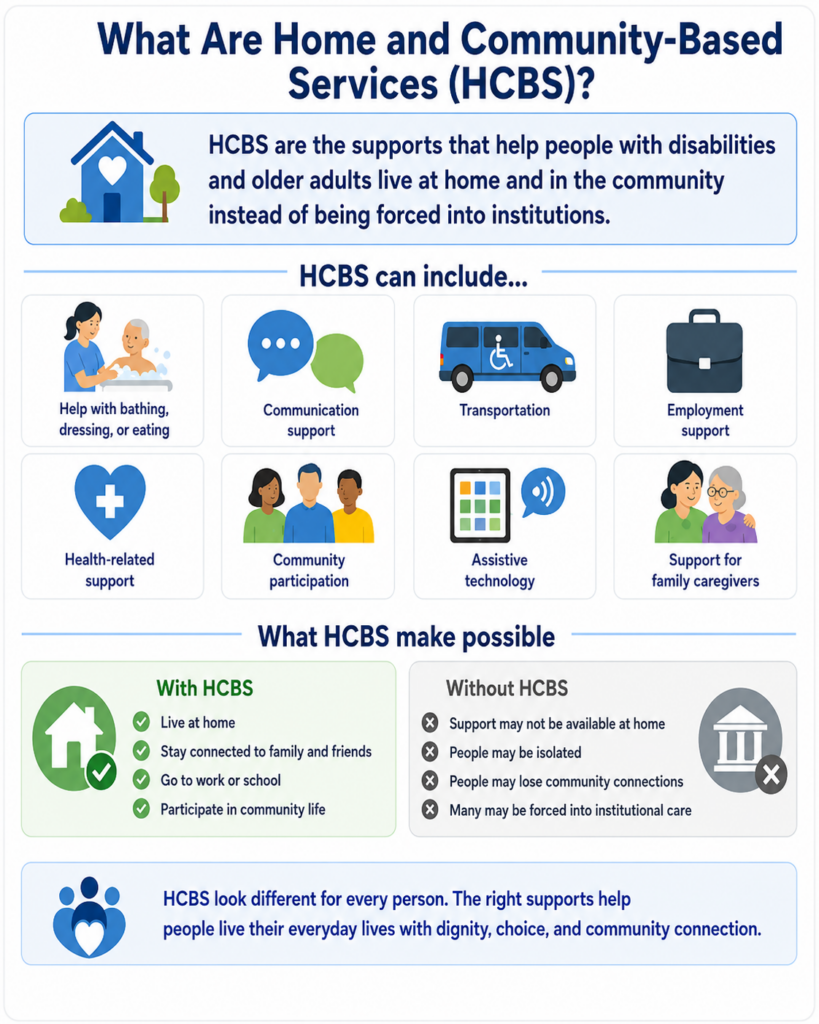
Home and Community-Based Services (HCBS) help people with disabilities and older adults live in their own homes and be valued members who actively participate in their communities instead of living in institutions or other segregated settings.
These services provide the support people need to live as independently as possible. Depending on the person, that support may include help with everyday activities, communication, employment, transportation, health-related needs, or participating in community life.
Without HCBS, many people may be forced to move into a nursing facility, institution, or another setting away from their families, friends, jobs, schools, and communities—not because they need institutional care, but because the supports they need are unavailable where they live.
Quick Definition: HCBS
Home and Community-Based Services (HCBS) are Medicaid-funded long-term services and supports that help eligible people with disabilities and older adults live in their homes and communities instead of institutions or other segregated settings.
What is a Medicaid waiver?
A Medicaid waiver allows a state, with federal approval, to use different Medicaid rules to provide services to certain groups of people. Many HCBS are provided through Medicaid waivers, but not all HCBS are provided through waivers.
Learn more about Medicaid waivers
Medicaid has federal rules about who must receive certain services and how those services are provided. A waiver allows a state, with federal approval, to set aside certain Medicaid rules so the state can design a program for a particular group of people.
1915(c) HCBS waivers are commonly used to provide long-term services and supports to people who meet the level of care that would otherwise qualify them for an institutional setting. Instead, the waiver can provide services that help them live in their homes and communities.
What can a waiver provide?
Depending on the waiver, services may include personal care, supports coordination, respite, habilitation, residential supports, employment supports, home modifications, assistive technology, transportation, and other services that support community living.
States can have more than one HCBS waiver. Different waivers may serve different groups of people and offer different services. States can also set a maximum number of people who may be served through a 1915(c) waiver. When more people need services than there are funded openings, people may have to wait.
Not all HCBS are provided through waivers. Medicaid also allows states to provide HCBS through other Medicaid authorities and state-plan options.
Key point: A waiver is not a payment or a specific service. It is one way Medicaid allows a state to create a program that pays for a group of home and community-based services.
Sources:
CMS — Home & Community-Based Services 1915(c) WaiversOpens in a new window
CMS — Home & Community-Based Services AuthoritiesOpens in a new window
➜ Why HCBS Matter
➜ Explain it to your neighbors
➜ Myths & Reality

You’ve completed Unit 1: Understanding HCBS.
Continue to Unit 2, or choose another Unit from the Table of Contents below.
Protecting and Strengthening HCBS Toolkit
Table of Contents
Choose a Unit below. You can go in order or choose the topic you need.

Unit 1: Understanding HCBS
Learn what HCBS are, why they matter, and how to explain them.
What will this Unit cover?
- What HCBS are
- Why HCBS matter
- How HCBS support community living
- Explain it to your neighbors
- Myths & Reality

Unit 2: Why are services for community living at risk?
Learn why HCBS have long been at risk and why current Medicaid cuts make that risk much greater.
What will this Unit cover?
- Mandatory and optional Medicaid benefits
- Medicaid’s institutional bias
- Federal Medicaid cuts and state budget pressure
- Why HCBS are especially at risk
- DOJ and Olmstead developments

Unit 3: What does this risk look like in real life?
Learn how problems in the HCBS system can affect whether people actually get the services and supports they need.
What will this Unit cover?
- Waiting lists and unmet needs
- Getting some services but still not getting enough
- The direct support workforce crisis
- Approved service hours that go uncovered
- Not enough providers
- Services or waivers that do not match a person’s needs
- Support coordination and administrative barriers

Unit 4: What a Strong HCBS System Looks Like
Learn how to protect the services people depend on now and strengthen HCBS for the future.
What will this Unit cover?
- Protecting HCBS funding and access
- Protecting HCBS funding and access
- A stable, qualified direct support workforce
- Enough providers to meet people’s needs
- Adequate reimbursement and sustainable services
- Services that match each person’s needs
- Meaningful support coordination and future planning
- Choice, autonomy, employment, housing, and community participation

Unit 5: Share Your Story and Make Your Voice Heard
Learn how to share your story and speak up with confidence.
What tools will I find in this Unit?
- Help understanding the issue
- Guidance for telling your story
- Preparing for meetings, calls, and emails
- Talking points and scripts
- Tips for speaking with legislators
- Follow-up tools

Unit 6: Stay Connected
Learn how to stay informed, follow up, and build relationships.
What tools will I find in this Unit?
- Ways to stay informed
- Tips for following up
- Building relationships with legislators
- Keeping the conversation going
- Sharing updates and information with others

Unit 7: Resources
Find fact sheets, videos, FAQs, printable materials, and trusted sources.
What will I find in this Unit?
- Fact sheets
- Videos
- FAQs
- Study guides
- Printable materials
- Sources and further reading
- Trusted HCBS resources


