

Speak Up → HCBS → Protecting & Strengthening HCBS Toolkit → Unit 2
UNIT 2 OF 7
Unit 2: Why are services for community living at risk?
What You’ll Learn
✓ Why Medicaid-funded home and community-based services (HCBS) are especially at risk
✓ How Medicaid waivers and optional Medicaid benefits can affect access to HCBS
✓ Medicaid’s institutional bias
✓ How federal Medicaid cuts and state budget pressure can increase the risk
✓ U.S. Department of Justice (DOJ), Section 504, and Olmstead developments
Threats to community living
- Changes to Medicaid funding and program rules can affect whether home and community-based services are available.
- Federal disability-rights protections that help people avoid unnecessary institutionalization are also being challenged.
Why are Medicaid-funded HCBS at risk?
HCBS have long been at risk because most Medicaid home and community-based long-term services and supports are optional for states, giving states more authority to limit, reduce, or change these services.
Why the risk is greater right now
Historic federal Medicaid cuts are creating significant new pressure on state Medicaid programs and budgets, increasing the risk that HCBS could be limited, reduced, or changed.
These cuts are arriving as states are also facing workforce shortages, rising demand for long-term services and supports, new administrative requirements, and other Medicaid cost pressures. Those existing pressures make the impact of the federal cuts even harder for states to absorb.
Why do pressures on the larger Medicaid program matter for HCBS?
HCBS are part of the larger Medicaid program. Medicaid also pays for many other health and long-term care services. States and the federal government share the cost of Medicaid, with federal matching dollars helping states pay for covered services.
What can put pressure on state Medicaid budgets?
Federal Medicaid cuts are one source of pressure, but they are not the only one. State Medicaid budgets can also be affected when:
- federal matching dollars are reduced;
- federal financing rules change and states can draw down fewer federal dollars;
- states must implement new federal eligibility, reporting, verification, or administrative requirements;
- health-care and prescription-drug costs rise;
- more people need long-term services and supports as the population ages;
- economic downturns reduce state revenue while Medicaid needs remain high or increase; and
- other changes increase the number or complexity of people needing health and long-term services.
States have to balance all of these costs within the Medicaid program. Because most HCBS are optional while some other Medicaid benefits are mandatory, HCBS are particularly exposed when states have to make difficult budget decisions.
How do Medicaid waivers fit into this?
Many HCBS are provided through Medicaid waivers. Because these waiver programs are optional, states can limit how many people they serve and how services are provided. When Medicaid funding is reduced and state budgets are under pressure, states may respond by limiting waiver enrollment, reducing services, or lowering provider payment rates.
Why does being “optional” matter?
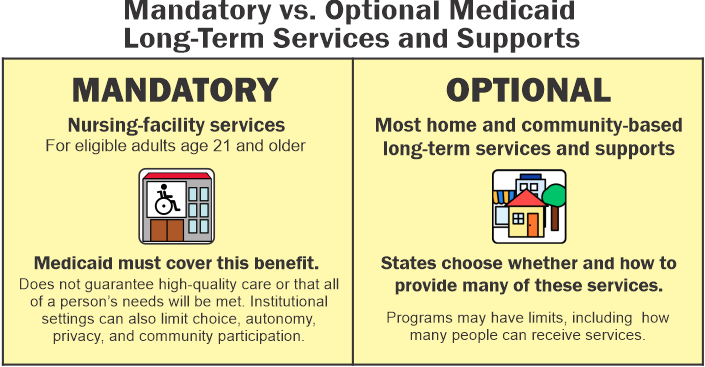
Nursing-facility services are a mandatory Medicaid benefit for eligible adults age 21 and older, while most Medicaid home and community-based long-term services and supports are optional for states.
“Optional” does not mean these services are unnecessary. It means federal Medicaid law gives states more choice about whether and how they provide many community-based services.
Disability advocates call this imbalance Medicaid’s “institutional bias.” An eligible adult who needs nursing-facility-level care may have a legal entitlement to the nursing-facility benefit, while access to services in the community may depend on the HCBS programs and capacity available in that state.
Why this matters:
A person may be entitled to Medicaid-funded nursing-facility care while access to the services that could support them in their own home and community may be limited.

KEY
CONCEPTS
✓ Most Medicaid home and community-based long-term services and supports are optional for states, while nursing-facility services are a mandatory Medicaid benefit.
✓ “Optional” does not mean unnecessary. It gives states more choice about whether and how to provide many community-based services.
✓ Federal Medicaid cuts and state budget pressure can increase the risk that HCBS will be limited, reduced, or changed.
Why are community-integration rights also at risk?
What is Olmstead?
Olmstead v. L.C. is a 1999 U.S. Supreme Court decision about the rights of people with disabilities to receive services in integrated community settings rather than being unnecessarily segregated in institutions.
The Court held that unjustified segregation of people with disabilities can be discrimination under Title II of the Americans with Disabilities Act (ADA). Under Olmstead, state and local governments may be required to provide community-based services when those services are appropriate, the person does not oppose receiving services in the community, and the services can be reasonably accommodated without fundamentally altering the public program.
In plain language: People with disabilities should not be forced to live in institutions simply because the services they need are not available in the community.
What changed in 2026?
In June 2026, the U.S. Department of Justice (DOJ) issued a legal opinion taking a new position on the federal integration mandate. The opinion argues that Section 504 of the Rehabilitation Act and Title II of the ADA do not themselves require states to provide services in the most integrated setting appropriate, and that Olmstead did not establish such a statutory requirement.
The concern became more immediate on August 31, 2026. DOJ, acting for the U.S. Department of Health and Human Services (HHS), joined states in asking a federal court to remove references to community integration from HHS regulations implementing Section 504, including the regulation’s integration provision. That proposed resolution relies on the June DOJ opinion.
This does not repeal the ADA, Section 504, or the Supreme Court’s Olmstead decision. But it represents a major change in the federal government’s interpretation and enforcement of community-integration protections. Disability-rights organizations are challenging that interpretation and maintain that Olmstead and longstanding legal precedent remain in effect
KEY
CONCEPTS
✓ Olmstead established that unjustified segregation of people with disabilities can be discrimination under the Americans with Disabilities Act (ADA).
✓ Community-integration protections help people receive services in their homes and communities instead of being unnecessarily institutionalized.
✓ Recent federal actions are challenging how these protections are interpreted and enforced, but the ADA, Section 504, and the Supreme Court’s Olmstead decision have not been repealed.
Explain it to your neighbors

You’ve completed Unit 2: Why are services for community living at risk?
Continue to Unit 3 to see what these risks look like in real life, or choose another Unit from the Table of Contents.


